2024 CIRCAA Capstone Project Posters
by Kaye Geaney, DNP, RN, AGCNS-BC, FNP-C

Abstract
Project Title:
Identifying Barrier and Gaps in Advanced Care Planning Documentation for the Older Adult
Project Team Members:
Mary Rubino, MD (project team lead), Faculty, Family and Community Medicine, Eastern Virginia Medical School (EVMS)
Kaye Geaney, DNP, FNP-C, AGCNS-BC (project team lead), Advanced Practice Provider, Family and Community Medicine, EVMS
Michael Layne, MD (project team member), Faculty, Family and Community Medicine, EVMS
Jeff Kail, LCSW (project team member), Behaviorist, Family and Community Medicine. EVMS
Project Objectives/Aims:
This quality improvement project aims to improve Advanced Care Planning (ACP) for the older adult through identifying barriers and gaps related to documentation. Additionally, this project aligns with the Age-Friendly Health System’s model of care by identifying “What Matters” to the older adult related ACP future medical care decisions.
Background:
The aim of Age-Friendly Health Systems is to provide high quality care by following evidence-based practices, causing no harm, and aligning care with “What Matters” to the older adult and their family (Duong et al., 2019). ACP is a process that supports the individual in understanding and sharing their preferences for future medical care (Kozlov et al., 2022). The goal of ACP is to ensure that future medical care decisions, or end of life care, is consistent with individual preferences or “What Matters.” ACP discussions can include the individual and their family members, significant others, caregivers, and healthcare providers (Duong et al., 2019). ACP documentation involves establishment of an advanced directive, and designating a healthcare agent that understands the individual’s preference for future medical care. Studies reveal that ACP engagement is associated with higher rates of end of life care consistent with individual preferences, or “What Matters,” and improved quality of life for the individual at end of life (Kozlov et al., 2022; Malhotra, 2023). Additional studies suggest that ACP engagement can reduce conflict between family members and healthcare providers during end of life discussions and better caregiver bereavement adjustment (Kozlov et al., 2022).
However, rates of ACP engagement in the United States are low for older adults, with fewer than two-thirds with ACP documentation (Phung, et al., 2021). Also, rates for ACP discussions and documentations in the US are lowest among non-English-speaking, racial/ethnic minorities, and marginalized older adult populations (Phung et al., 2021). Studies suggest that multiple factors impact barriers and gaps for ACP among diverse older adult populations, common factors include: a) discomfort discussing ACP; b) “God” will decide my future medical care; c) do not want to burden family and friends; d) assume that family and friends already know their preferences for future medical care; e) assume that healthcare providers already know their preferences for future medical care; f) mistrust in healthcare provider or system; g) too many options to consider for future medical care; and g) not the right time to discuss ACP (Radhakrishnan et al., 2017; Phung et al., 2021).
The proposed survey can assist in identifying barriers or gaps in ACP and help address deficits in ACP documentation for older adults, including EVMS Senior Strong Clinic patients.
Project Plan:
Procedures:
- EVMS will offer patients scheduled at the Senior Strong Clinic an anonymous survey on ACP if they do not already have an ACP document on file in their chart. Patient survey participation is voluntary. The patient may choose to include any family members present at their visit in the survey process.
- Patients will document their responses in a secure Redcap database.
- Proceeding to the survey link and completing the survey serve as consent to participate in the survey.
Evaluation Plan:
- Descriptive statistics will be used to evaluate patient self-reported barriers/gaps in ACP documentation.
by Erica Chigos-White, NP-C
Abstract
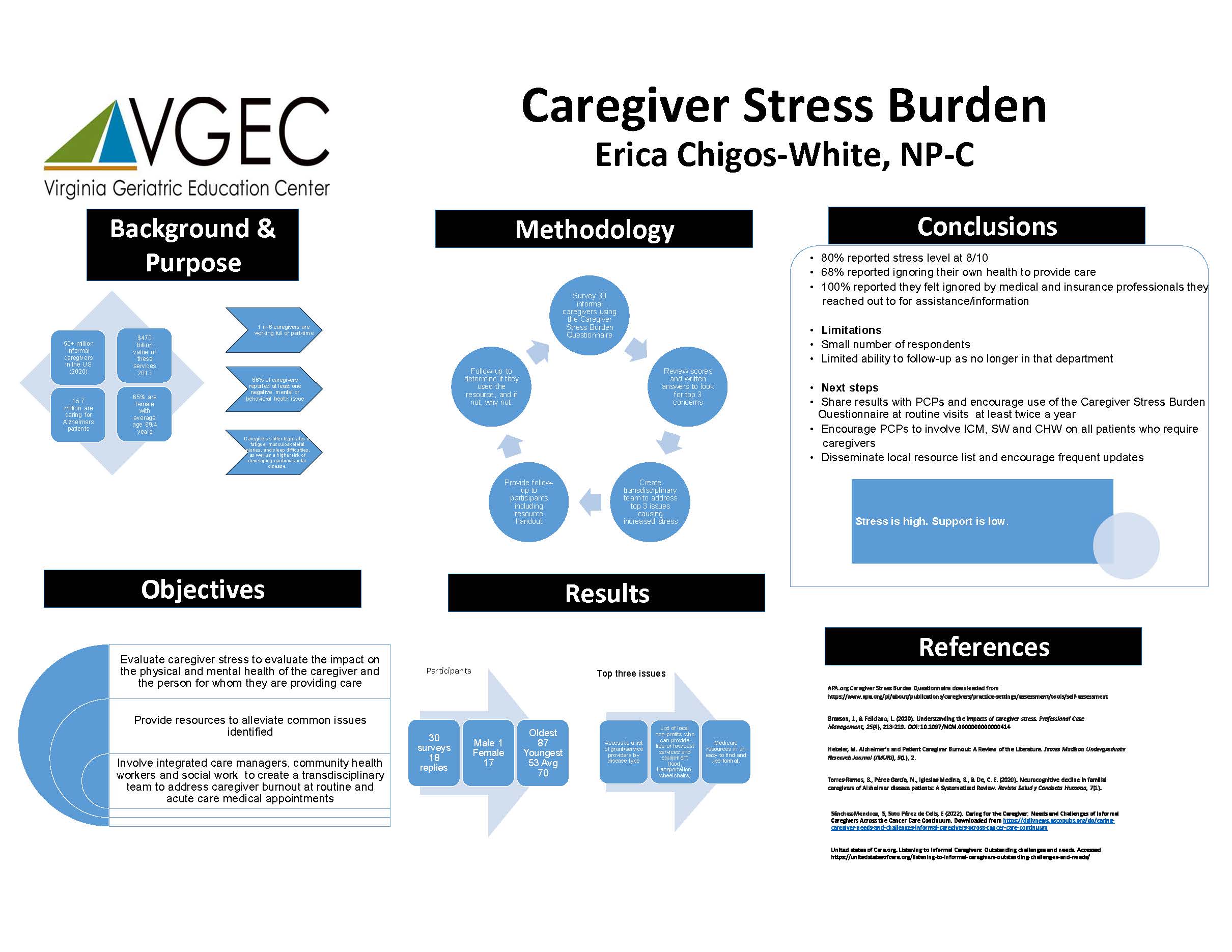
This project involved surveying informal caregivers to determine the level of stress they experience from the day to day caregiving. Thirty persons agreed to participate but ultimately only 18 responded. A universal response to being asked how they were doing was no one had asked them that before. A majority stated family members expected them to provide all the care for the family member yet did not offer support either actual or financial. Worse, many reported they’d be criticized if the person for whom they were providing care declined in health or was taken to the emergency department. In response to the request for a resource list, one was created. Caregivers reported needing help navigating Medicare, Medicaid, and private insurance as a source of stress was obtaining and maintaining durable medical equipment and needed but not covered items. Ideally, transdisciplinary team consisting of Providers (MD, DO, NP, PA), Social Work, Integrated Care Managers, and Community Health Workers would have been convened to address this issue. The number of informal caregivers will continue to grow; providing care to this group will be essential in maintaining this resource.
by Tanner Brandon, PharmD

Abstract
Pharmacists possess a strong capability to identify potential ocular side effects linked with medications. Yet, there’s a notable absence of their collaboration with optometrists in interprofessional environments. The project objectives were to evaluate the use of a medication evaluation form in helping to identify high-risk medications in older adults. In addition, the objective was to design a reference guide for staff use listing the recommended procedures and screening interventions for patients who report taking said high-risk medications.
The study results highlight the advantages of conducting distinct medication assessments within optometry settings, aiming to foster greater collaboration between pharmacists and optometrists. Furthermore, this initiative aligns with the principles of the 4Ms framework by innovatively evaluating medication utilization in older adults within a novel clinical context.
by Christine JD Bryant, PharmD, BCGP
Abstract
Background:

Inpatient rehabilitation offers comprehensive physical rehabilitation, employing a thorough, multi-disciplinary strategy overseen by physicians to effectively address the needs of complex patients, many of whom have difficulty participating in personalized regimens due to pain.1 The goal is to optimize patient participation in rehabilitation by reducing pain and enhancing endurance. Through an integrated pain management program, coordinated care is a prioritized aiming to alleviate pain and restore patients’ daily functioning. The transdisciplinary pain management program commits to equipping patients with coping mechanisms while focusing on pain relief and enhancing their ability to perform daily activities.2,3.
Objective:
To establish a dedicated committee at Sheltering Arms Institute to optimize pain management practices and implement innovative strategies, including alternative modalities and therapeutic techniques, ensuring safe and effective pain relief.
Goals:
- Standardize pain medication administration by establishing clear protocols for scheduled versus as-needed (PRN) dosing, while integrating various modalities for comprehensive pain management.
- Enhance pain management practices by implementing robust tracking and administering systems, ensuring precise monitoring and timely interventions.
- Develop strategies to maintain opioid-naïve patients in their current state while effectively managing their pain through non-opioid interventions and personalized treatment plans.
- Foster transdisciplinary collaboration and coherence by establishing unified terminology and approaches to pain assessment, treatment, and communication across all medical and therapeutic disciplines.
Methods:
Discussions and interviews were conducted with Physicians, Nursing, and Therapy Leads (PT, OT, Recreational Therapy) to determine needs and desires for a dedicated committee for pain management, regulatory requirements were reviewed, and brainstorming sessions were held.
Results:
Existing initiatives in pain management were identified that included a Pain Education Series class and a Pain Ambassadors Program. It was determined that an Opioid Stewardship Program would complete this committee to create a more robust pain management program.
Next steps:
- Ensure regulatory requirements surrounding pain management are met.
- Identify key outcomes to measure success.
- Continue to thrive with the goal of making Sheltering Arms Institute an age-friendly organization.
by Alicia Thompson, LCSW

Abstract
This project addresses institutionalized ageism and the stigma that older adulthood is a time when growth and development edn, older adults don’t have a voice, and older adults can’t pursue interests and connections of choice in elderhood.
by Tamika Atkins, CDA

Abstract
The geriatric population is in greater need of medical, dental, and everyday care assistance. With the aid of physicians, nurses, certified nursing staff and others qualified to give good home health care to this population. It is a challenge, but what isn’t. This reading is well needed in the field of health to be able to give effective care to the aging. This project is a blueprint of a course to be developed to bring awareness to the lack of geriatric dentistry based on lack of knowledge. The outcome is bridging the gap between medical and dental disciplines to provide dental care to the aging population.
by Christopher Nein, MD, FAAFP

by Christy J. Jensen, PhD

Abstract
The Purple Flower Program (PFP) at Riverside Health promotes dementia awareness, education and skills building in its 4 hospitals and will expand to primary care sites. Many of the acute care staff have limited, if any, training opportunities to advance their understanding of dementia and how to engage most effectively with and care for persons with memory loss. The PFP is a multi-faceted approach that includes: 1) acute care team member training (online and in-person); 2) A purple flower symbol at the patient’s door which serves as an internal indicator to the interdisciplinary care team to utilize their person-centered approaches; 3) Resource cards for family caregivers to build PFP awareness and linkage to internal and community-based resources; and 4) Engagement items (e.g., therapeutic baby doll, activity apron) offered to patients based on need. This project has addressed the impact of the training program on acute care team members. 385 team members completed a brief online survey in February of 2024. This survey was based on the CODES, Confidence in Dementia Care Scale, where knowledge and confidence, are assessed. Survey results are encouraging as 82% of team members report the training improved their confidence in caring for or supporting people living with dementia; 91% feel comfortable being around people with dementia; and 96% report they are able to help a person with dementia feel safe during their time in the hospital. Based on a small focus group (n=5), team members expressed appreciation for this opportunity to advance their skills, citing personal and professional gain, and they identified the need for ongoing training and a streamlined process to provide engagement items for PFP patients.
by Yvette Cantrell-Hunter, BSN, GERO-BC, NREMT

Abstract
Out of the hospital setting, patients and caregivers are at high risk for making errors. Errors in the home are reported to occur at rates between 2-33%. Wrong dose, missing doses, and wrong medication are the most commonly reported administration errors. Contributing factors to patient and caregiver error include low health literacy, and poor provider–patient communication. By having highly complex medication regimes simplified and managed more by the patient in their daily life, providers have a more complete picture of the patient’s medication routine. Physicians can now see possible drug interactions, resolve insurance issues and identify gaps in therapy. The purpose of the trial would be to reduce ER, urgent care or IP admissions of patients related to medication errors for the diagnosis of diabetes, hypertension and chest pain.
by Ann Welch, RN, BSN, PMHN-BC

by Ashley Staton, MSW

Abstract
There are more than six million Americans with dementia, a group of diseases characterized by loss of memory, language, problem-solving and other thinking abilities that are severe enough to interfere with daily life, and this number is expected to double by 2050. Those with dementia often face additional challenges as they search for available resources, such as geographical limits and gaps in dementia-friendly care, and stigma around their age and/or disease. Social workers are likely to encounter those with dementia in a variety of settings including healthcare, homeless shelters, police departments and child protective services, but are often underprepared for the demands of these clients. Many social work programs do not address the specific needs of older adults or those with dementia due to limited interest and capacity. This project is designed to address this gap in curriculum by introducing the concept of dementia in already established courses to complement existing teaching materials with the objective of introducing this vital information to social work students and measuring their comfort with the subject using the Confidence in Dementia (CODE) scale.
by Andrea D. Price, MSS, MPS, MBA
Abstract

In 2022, an estimated 11.48 million caregivers in the United States supported individuals with Alzheimer’s disease and related dementias (ADRD), with approximately 88% having access to mobile devices and apps. Despite this widespread access, there’s a notable gap in mobile applications tailored to their specific needs. Existing apps often provide generalized support, overlooking the unique challenges faced by dementia caregivers.
This project aims to bridge this gap by developing a framework for a web-based application designed for dementia caregivers, grounded in the principles of the 4Ms—What Matters, Medication, Mentation, and Mobility. Through the utilization of Design Thinking, Lean Startup, and Agile methodologies, stakeholders including caregivers, healthcare professionals, app developers, and designers will collaborate to create a user-friendly solution. Together, they’ll enhance dementia caregiver app offerings and promote age-friendly healthcare.
by Nicole Meredith, BSN, RN, CSSM, CNOR

Abstract
Objectives:
Use the 4M’s Framework to design an intuitive approach (toolkit) to facilitate ease of access retrieving and storing SDOH resources. Integrate the electronic SDOH toolkit approach to retrieving and storing into clinic practice. Evaluate the interdisciplinary usage of the electronic SDOH toolkit.
Background:
According to the CDC, Social Determinants of Health (SDOH) are non-medical factors that influence health outcomes. Our complex care clinic’s affiliation with a large University Healthcare Organization affords staff’s ability to access many resources. Staff report post-COVID outdated telephone numbers, incorrect contacts, and the rise and closure of small businesses have left vital resource tools ubiquitous. The everchanging health care landscape complicated by overburdened community resources requires a certain amount of efficiency and creative finesse to link patients with appropriate resources in a timely manner (thereby having the greatest impact on optimal health outcomes). A literary search produced one study indicating, “most providers were unaware of local resources to which screened patients can be immediately referred. Based on the identified gaps in practice, a toolkit was developed that included recommended screening tools, algorithms for implementing screening and referral, and a list of available local community resources that address specific SDOH.”
Aim Statement:
Create an electronic toolkit for the Complex Care Clinic team to access SDOH resources with ease.
Methods:
- Appraise which SDOH resources are currently in use by the Complex Care Clinic team members
- Facilitate dialogue regarding the electronic SDOH resource toolkit (via Mentimeter)
- Utilizing an electronic file folder format via the Complex Care Clinic’s TEAMS page, staff will access SDOH resource tools arranged via the 4M’s framework (What Matters Most, Medication, Mentation and, Mobility)
Results:
Baseline data was collected via a two question Mentimeter survey. Six respondents (of ten staff members) provide feedback in support of an updated, centralized, easy to use SDOH toolkit. All staff report SDOH resource information needs to be updated and/or they are not aware of organizational resources.
Conclusion and Recommendations:
All six respondents report this SDOH resource toolkit was helpful. The following are recommendations after careful consideration of the evidence provided by this literary research and respondents’ feedback:
- This quality improvement project may benefit from additional participants to maintain/update information.
- This quality improvement project may benefit from expanding (from an individual leader approach) to a diverse, interdisciplinary team approach (thereby each team member may contribute their unique expertise to continue to vet, update, and expand the electronic SDOH resource toolkit).